
Ghana's Chief Justice Controversy: Torkornoo’s Removal and the Contentious Vetting of Baffoe-Bonnie
In a day thick with political tension and legal uncertainty, Ghana’s Parliament's Appointments Committee is, as of this morning, November 10, 2025, proceeding with the public vetting of Justice Paul Baffoe-Bonnie to become the 16th Chief Justice of the Republic. The move signals a climax in an 8-month constitutional drama that has seen the unprecedented removal of a sitting Chief Justice, a fierce executive-judiciary standoff, and legal battles stretching from Accra's Supreme Court to the ECOWAS regional court.
This article details the full timeline of events, from the swearing-in of Justice Gertrude Torkornoo to the controversial vetting of her replacement, exploring the constitutional, political, and legal undercurrents that have defined one of the most turbulent periods in Ghana's judicial history.
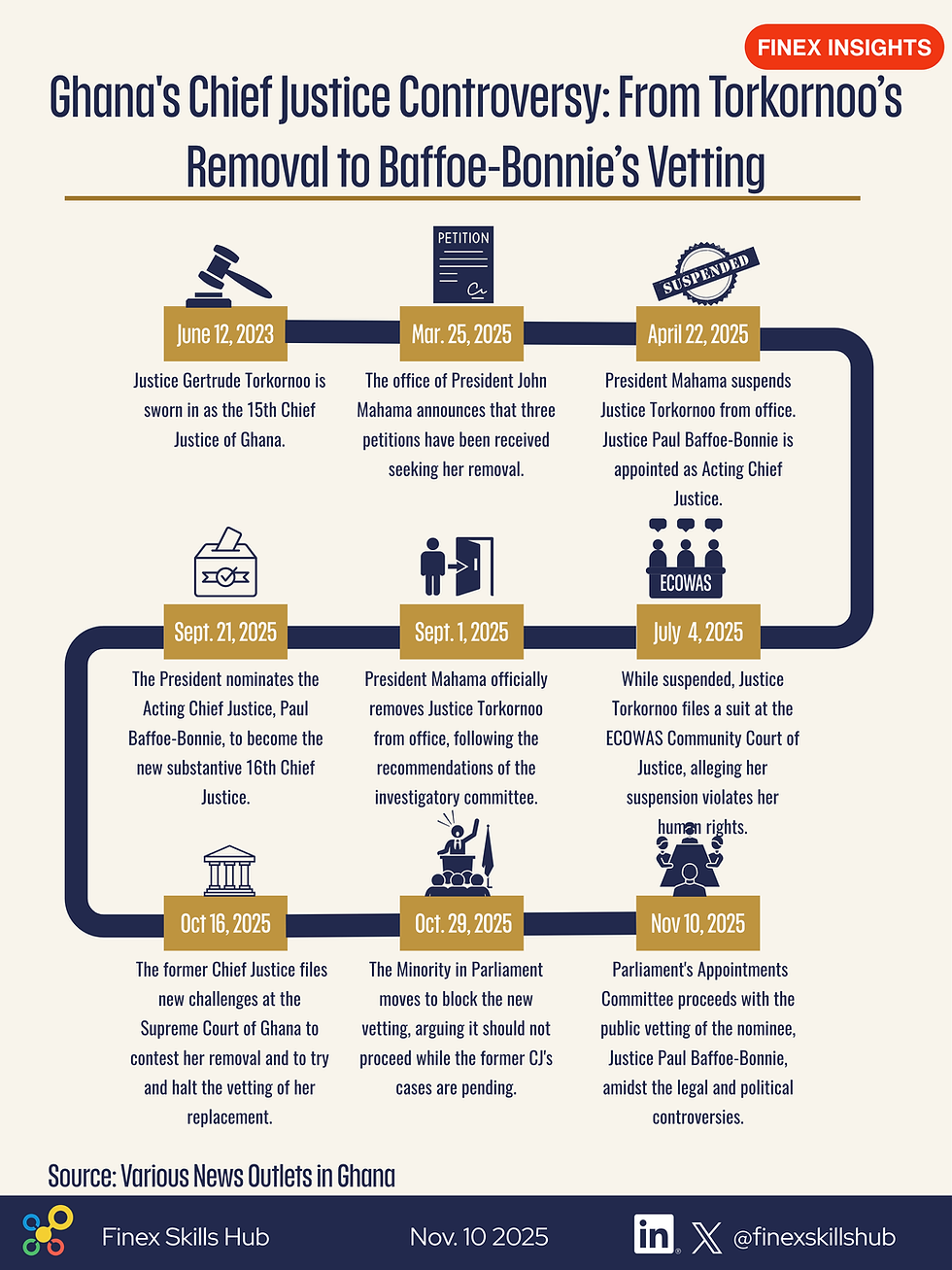
The Beginning: Justice Torkornoo's Ascent
The story begins just under 18 months ago. On June 12, 2023, Justice Gertrude Araba Esaaba Torkornoo was sworn into office as the 15th Chief Justice of Ghana. Her appointment was met with widespread approval. A distinguished jurist with a deep background in both private practice and the judiciary having served at the High Court, Court of Appeal, and Supreme Court since 2004 she was seen as a reform-minded leader, particularly known for her advocacy for judicial ethics and the integration of technology through the e-Justice system.
Her swearing-in was a moment of celebrated transition, marking her as the third woman to hold the nation's highest judicial office. Few could have predicted the constitutional storm that would gather less than two years into her tenure.
The Seeds of Conflict: Petitions and Suspension
The first public sign of trouble emerged on March 25, 2025. The office of President John Mahama, who had assumed the presidency, released a terse announcement: three separate petitions had been received seeking the removal of Chief Justice Torkornoo from office.
The petitioners were identified as a private citizen, Mr. Daniel Ofori; an Assistant Commissioner of Police, ACP Ayamga Yakubu Akolgo; and a group named Shining Stars of Ghana.
While the presidency was initially tight-lipped, the specific allegations across the petitions soon circulated, painting a grim picture of the accusations. They included:
Financial Misconduct: Allegations that the Chief Justice had improperly used public funds to cover private travel expenses for herself and her family, including business class flights and per diem allowances.
Abuse of Administrative Power: Politically sensitive claims were made that Justice Torkornoo had arbitrarily transferred judges and cases, most notably the high-profile case of The Republic v. Stephen Kwabena Opuni, allegedly to secure outcomes favourable to the previous (Akufo-Addo) administration.
Unlawful Arrest and Detention: A personal and direct allegation from ACP Akolgo, who claimed the Chief Justice had capriciously abused her power to cause his wrongful arrest and detention.
The process moved with unexpected speed. On April 22, 2025, President Mahama, acting on the advice of the Council of State as prescribed by Article 146(10), took the decisive step of suspending Justice Torkornoo from office. The suspension, the presidency explained, was to allow the newly formed investigatory committee to conduct its work without interference.
Simultaneously, to prevent a vacuum in the judiciary's leadership, Justice Paul Baffoe-Bonnie, the most senior Justice on the Supreme Court bench, was appointed as the Acting Chief Justice.
Justice Torkornoo did not accept her suspension passively. On July 4, 2025, while the domestic committee was presumably still sitting, Justice Torkornoo's legal team filed a suit at the ECOWAS Community Court of Justice in Abuja. This move was significant. The suit framed the suspension itself as a violation of her fundamental human rights. Her lawyers argued that the suspension, and the process leading to it, infringed on her rights to fair hearing and administrative justice, principles enshrined in the African Charter on Human and Peoples' Rights, which the ECOWAS court has jurisdiction to enforce.
An Official Removal
While the ECOWAS suit was pending, the domestic Article 146 process reached its definitive conclusion. On September 1, 2025, the Presidency issued a formal statement: President John Mahama had officially removed Justice Gertrude Torkornoo from the office of Chief Justice.
The statement clarified that this action was not a discretionary decision but a constitutional obligation. The President was acting in accordance with the binding recommendations of the five-member investigatory committee.
According to reports on the committee's findings, the panel had concluded that several of the allegations of "stated misbehaviour" and "incompetence" were established. The key findings that reportedly led to the recommendation for removal included:
Unlawful Expenditure of Public Funds: The committee found that Justice Torkornoo had improperly caused the Judicial Service to pay for private travel expenses for her family members. The report allegedly described this as an "avoidable and reckless dissipation of public funds."
Abuse of Discretionary Power: The committee concluded that her handling of administrative transfers, specifically involving the judge in the high-profile Republic v. Stephen Kwabena Opuni case, breached the constitutional requirement for the fair and impartial exercise of discretionary power.
Interference in Judicial Appointments: She was also found to have attempted to bypass established nomination protocols for new Supreme Court Justices.
The Path to Replacement: Baffoe-Bonnie's Nomination
With Justice Torkornoo officially removed, President Mahama moved to fill the vacancy. On September 21, 2025, the President nominated the Acting Chief Justice, Paul Baffoe-Bonnie, to become the new substantive 16th Chief Justice.
Justice Baffoe-Bonnie, a veteran jurist appointed to the Supreme Court in 2008 by President John Kufuor, is widely respected for his long service. His nomination, however, was immediately entangled in the legal and political controversy surrounding his predecessor.
A New Court Challenge and The Parliamentary Standoff
The nomination of Justice Baffoe-Bonnie immediately prompted a new, direct legal challenge. On October 16, 2025, former Chief Justice Torkornoo filed a Judicial Review action at the High Court. This suit was a comprehensive assault on the entire removal process and, more urgently, sought to directly halt the appointment of her successor.
In her application, Justice Torkornoo asked the court for specific, powerful reliefs:
To quash all proceedings, reasons, and recommendations of the investigative committee, which had been chaired by Justice Gabriel Scott Pwamang.
To declare the Presidential Warrant that officially removed her from office as unlawful, void, and of no effect.
To stop all procedures and processes for the appointment of her successor, Justice Paul Baffoe-Bonnie, whose vetting was now the next logical step.
The battle lines shifted from the courts to the legislature. On October 29, 2025, the Minority in Parliament filed a formal motion to block the vetting of Justice Baffoe-Bonnie. Their argument was that, Parliament should not proceed with a vetting that would legitimise Justice Torkornoo's removal when that very removal was the subject of active lawsuits at both the High Court and the ECOWAS Court.
The Minority leader argued that for the Appointments Committee to proceed would be to disrespect the judiciary and pre-empt the high courts' rulings.
This brings us to today, November 10, 2025. Despite the Minority's motion and the clear legal cloud, Parliament's Appointments Committee has commenced the public vetting of Justice Paul Baffoe-Bonnie. The decision to proceed underscores a deep divide, with the Majority side presumably arguing that the executive has fulfilled its constitutional mandate and that Parliament's duty to vet is separate from any pending court cases.
As Justice Baffoe-Bonnie fields questions from the committee today, he does so amidst a firestorm. The judiciary, the institution he is poised to lead, is watching. The public is watching. And the unresolved legal ghosts of his predecessor's removal hang over the entire proceeding, leaving Ghana's democracy to navigate a profoundly complex test of its institutional resilience.


Very very easy to read and understand given the terminologies of law.