
Ghana’s Debt Outlook, WASSCE Funding, and the Payroll Controversy: Today’s Economic Breakdown
Today’s data reveals a rise in the dollar-to-cedi exchange rate across the Bank of Ghana, Visa, and Aboki exchange channels, while diesel prices show significant variations between major distributors. As Brent Crude hovers near $100, the domestic news cycle is dominated by the IMF’s latest debt projections and a major clarification regarding a massive payroll error. Let’s analyze the latest data and emerging trends shaping Ghana's economic landscape.

Market Movers: Today’s Key Indicators
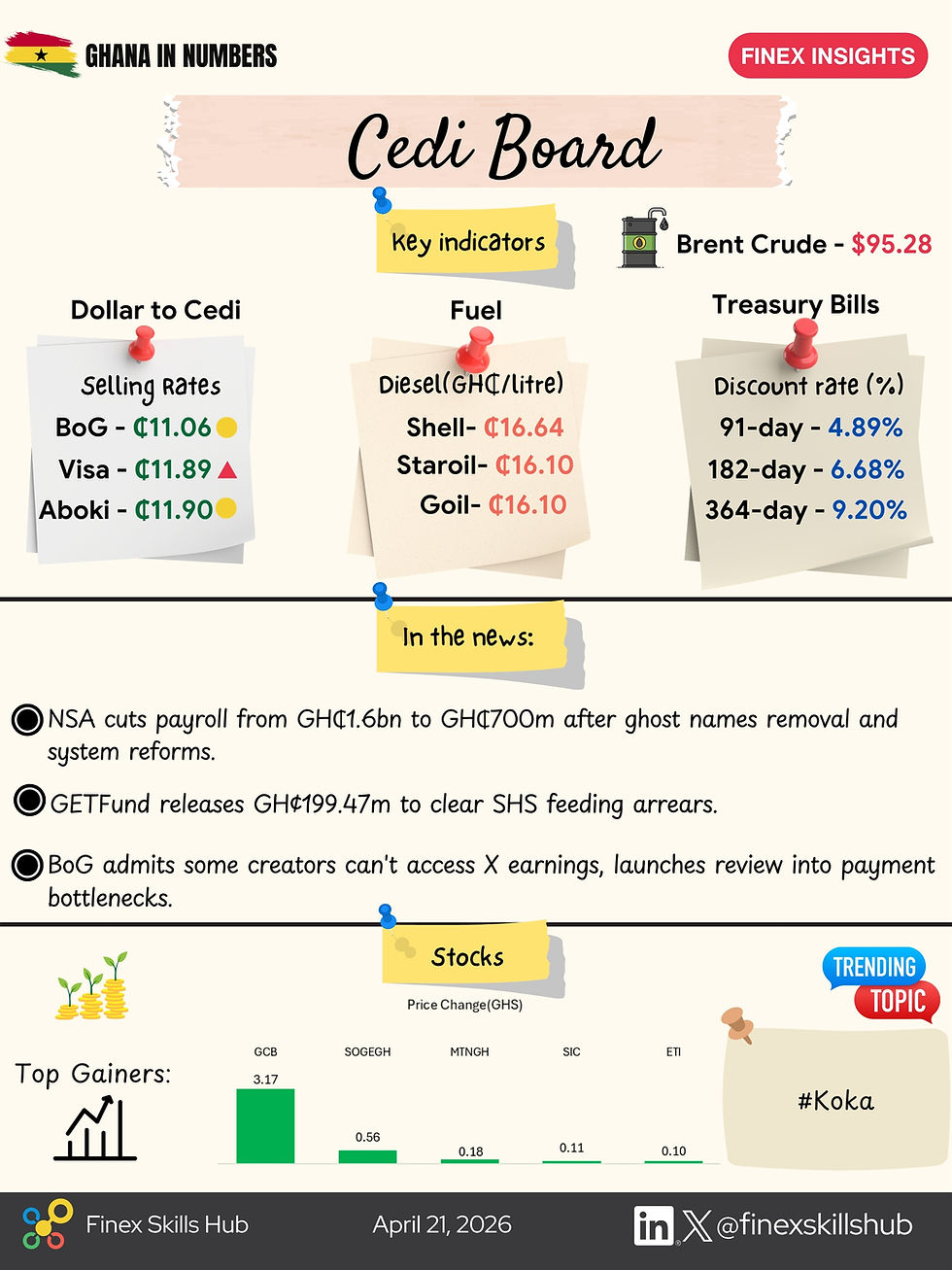
Currency and Commodities
The cedi is under pressure today as all tracked selling rates have moved upward. The Bank of Ghana rate stands at ₵11.07, while the Visa rate is ₵11.90, and the Aboki rate has reached ₵12.10.
In the energy sector:
Brent Crude: $99.64 per barrel.
Fuel (Diesel): Total is selling at ₵18.50/litre, Zen at ₵17.97/litre, and Allied at ₵17.50/litre. Gold Investment Products Prices for Goldbod Jewellery Tablets have remained stable for a while.
5g: ₵11,485.26
10g: ₵22,044.29
31g: ₵66,614.52
Stock Market Top Gainers
The Ghana Stock Exchange shows some positive movement today, led by the banking and energy sectors.
GCB: 3.49
ETI: 0.12
SOGEGH: 0.08
GOIL: 0.06
CAL: 0.03
Notably, GCB has been the number one gainer for three consecutive days.
IMF Projects Rise in Ghana’s Debt-to-GDP to 53% by 2026
The International Monetary Fund (IMF) recently released its Fiscal Monitor Report, projecting that Ghana’s debt-to-GDP ratio will climb to 53% by the end of 2026. This is a notable increase from the 45.3% recorded in 2025. The "debt-to-GDP ratio" is essentially a measure of how much the country owes compared to the value of everything it produces.
While the report notes that these projections are based on a post-debt restructuring scenario, it highlights a delicate balancing act for the government. On one hand, the economy has grown to an estimated ₵1.4 trillion, but on the other hand, the government is returning to long-dated domestic borrowing, such as the recent 7-year bond issued at a 12.5% interest rate. Finance Minister Dr. Ato Forson aims to return Ghana to a "moderate risk of debt distress" by 2028, but for now, the rise suggests that the cedi’s value and future tax policies will remain under a very tight microscope.
GES Releases Funds for 2026 WASSCE Practicals
In a move that provides immediate relief to thousands of households, the Ghana Education Service (GES) has officially released funds to Senior High Schools (SHSs) nationwide. This money is specifically earmarked to cover the fees and material costs for the 2026 WASSCE practical examinations.
This is significant because, in previous years, delays in fund releases often led to schools asking parents to contribute for basic materials like chemicals for science labs or ingredients for home economics exams. By handling this centrally, the GES is effectively removing a sudden "out-of-pocket" expense for parents during an already expensive exam season.
CAGD Clears the Air on GH₵427m Salary Report
The Controller and Accountant-General’s Department (CAGD) has stepped forward to dismiss a viral report by The Fourth Estate claiming that a single senior civil servant was paid over GH₵427 million in irregular salaries. This story originally gained traction following an investigative report, but it has since been clarified as a massive "transpositional error" by the Auditor-General.
The Auditor-General apologized, explaining that the figure actually represented 3,476 staff members at the Ministry of Education who were unaccounted for during an audit, not one person hitting a jackpot. The CAGD was quick to point out that their system has multiple "fail-safes," including online validation by heads of departments and automated pay structures, which would make a single payment of that size impossible.
Trending Topic: #Tithe
The hashtag #Tithe is currently trending across Ghanaian social media due to a heated confrontation at a Methodist Church. A video went viral showing a female member publicly calling her pastor and elders "thieves" during a service.
The root of the anger was a church policy that allegedly denies welfare or financial support to members who do not regularly pay their tithes. This has ignited a fierce national debate: should a church, which many view as a charitable and spiritual refuge, treat welfare like an insurance policy where you only get out what you put in? While some argue that tithes are necessary to fund church operations and help others, many Ghanaians feel that tying basic compassion and support during bereavement or illness to financial contributions is a step too far.
Key Takeaways
Today’s economic landscape is a mix of rising costs and institutional adjustments. The steady climb of the dollar against the cedi, combined with a projected rise in national debt, suggests that the cost of living may remain high for the foreseeable future. However, the release of WASSCE funds offers a tangible financial cushion for families, and the clarification on the payroll error helps restore some level of confidence in public financial management systems. As the conversation around tithing shows, the intersection of money and social support remains a very sensitive topic for the everyday Ghanaian.
Follow Finex Insights for daily insights into Ghana's economic pulse.


Comments