
The Math Behind Accra’s Dry Taps: Demand, Deficits, and Disappearing Water
Across Ghana, getting water to flow consistently through household taps remains a major challenge. While some communities experience more severe shortages than others, the issue affects daily life nationwide.
The situation is especially bad in the Accra-Tema Metropolitan Area (ATMA). In a recent interview, the Managing Director of GWCL, Adam Mutawakilu, gave some eye-opening figures about the "bottleneck" in the capital. His data shows a massive gap between the water the city needs and what is actually being produced, along with huge losses in money that make fixing the problem even harder.
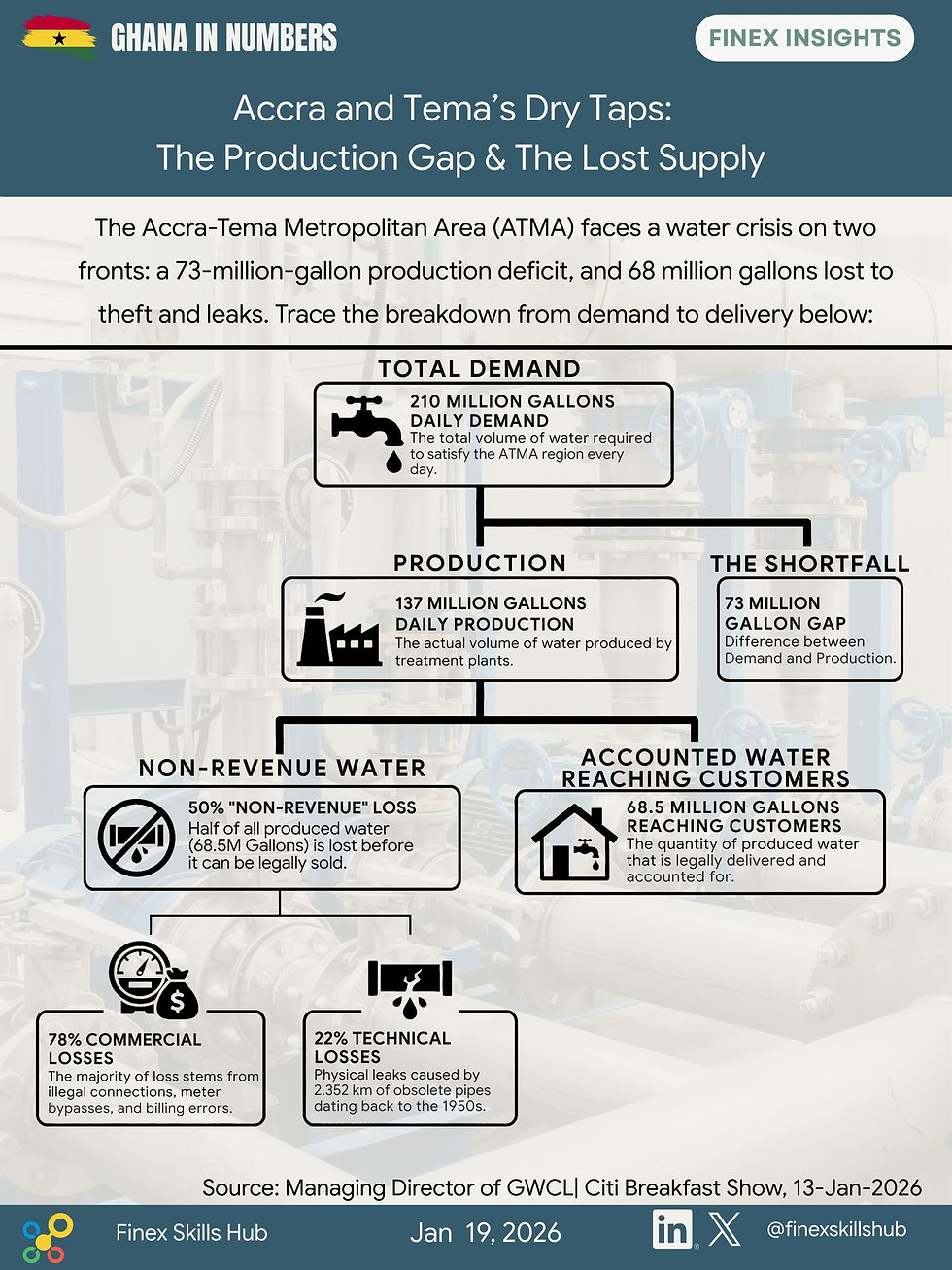
The Numbers: A Widening Production Deficit
The gap between what is needed and what is produced is the first hurdle for the region.
Total Daily Demand: ATMA requires 210 million gallons per day to satisfy residents and businesses.
Actual Production: Current treatment plants only produce 137 million gallons daily.
This explains why the GWCL is forced to use rationing. This means while one neighborhood has water, another is cut off. For the average citizen, this doesn't just mean an empty tap; it means:
The "Midnight Hunt": Families staying awake into the early hours of the morning to fill barrels when pressure finally rises.
Extra Costs: When the taps fail, people are forced to buy expensive sachet water or pay private tankers, which often cost five to ten times more than the official GWCL rate.
The Immediate Shortfall: This leaves a 73-million-gallon gap before a single drop even enters the distribution network.
The 50% Leakage: Where the Water Vanishes
Perhaps the most startling figure is the "Non-Revenue Water" (NRW). Of the 137 million gallons produced, 50% (68.5 million gallons) is lost to theft or leaks, never reaching the company's billing system.
This means that while 137 million gallons are treated, only 68.5 million gallons are legally accounted for and delivered to customers. This accounted water represents a mere 32% of the total regional demand.
Analyzing the Causes: Theft vs. Infrastructure
The GWCL categorizes these massive losses into two distinct areas:
78% Commercial Losses: The vast majority of water loss is attributed to "commercial theft". This includes illegal connections, meter bypasses by large-scale businesses (such as sachet water plants), and billing discrepancies.
22% Technical Losses: These are physical leaks caused by a crumbling network. The GWCL manages over 2,352 km of obsolete pipes made of asbestos and concrete, some of which have been in the ground since the 1950s.
This loss impacts the citizenry in two major ways:
Contamination Risks: When pipes leak or burst, the pressure drops. This allows dirty groundwater or sewage to seep into the broken pipes, putting families at risk of waterborne diseases like cholera or typhoid.
Higher Tariffs: Because the GWCL is losing millions of cedis in "missing" water, they have less money to fix the system. To keep running, the cost of these losses is often passed down to the honest, paying customers through higher water bills.
Operational Response and Future Outlook
In response to these findings, the GWCL is shifting its management strategy from passive distribution to active enforcement.
Managerial Accountability: 41 out of 103 district managers are being reassigned for failing to curb illegal connections or meet revenue targets.
Revenue Enforcement: The "Revenue Enhancement Team" is being expanded from 3 to 12 specialized units to identify and disconnect illegal users.
Digital Transition: To reduce human error and theft, the company is pushing for a digital payment transition, as currently only 20-30% of customers pay through the mobile app.
Infrastructure Investment: Long-term relief depends on the proposed $300 million Kpong Phase 2 expansion, which is required to bridge the production shortfall.
The data suggests that until the twin issues of commercial theft and 70-year-old infrastructure are addressed, the ATMA region will continue to face a "dry tap" reality despite the water being produced at the source.


Comments