
From SSNIT to Société Générale: The 51-Year Journey of the Ghanaian Bank Set for Moroccan Ownership.
How a bank established by Ghana's pension fund in 1975 evolved through mergers, privatisation and French majority ownership before its latest proposed transition to Attijariwafa Bank.
A Ghanaian Bank With an Unusual Ownership Story
In February 1975, the Social Security and National Insurance Trust (SSNIT) established Security Guarantee Trust Limited as its wholly owned institution. Five decades later, that same bank, now known as Société Générale Ghana, is preparing for another significant ownership transition.
On October 1, 2026, Société Générale Group announced an agreement to divest its entire 60.22% shareholding in its Ghanaian subsidiary. Under the proposed transaction, Morocco's Attijariwafa Bank will acquire 55.22%, while SSNIT will purchase the remaining 5%.
The development brings an interesting dimension to Ghana's banking history: the institution that originally established the bank is increasing its ownership as the French banking group prepares to depart. From a Pension Fund Investment to a Commercial Bank
The bank's journey began on February 7, 1975, when it was incorporated as Security Guarantee Trust Limited, with SSNIT as its sole shareholder.
In February 1976, it was renamed Social Security Bank Limited (SSB). It subsequently received its banking licence in September of that year and officially opened to the public in January 1977.
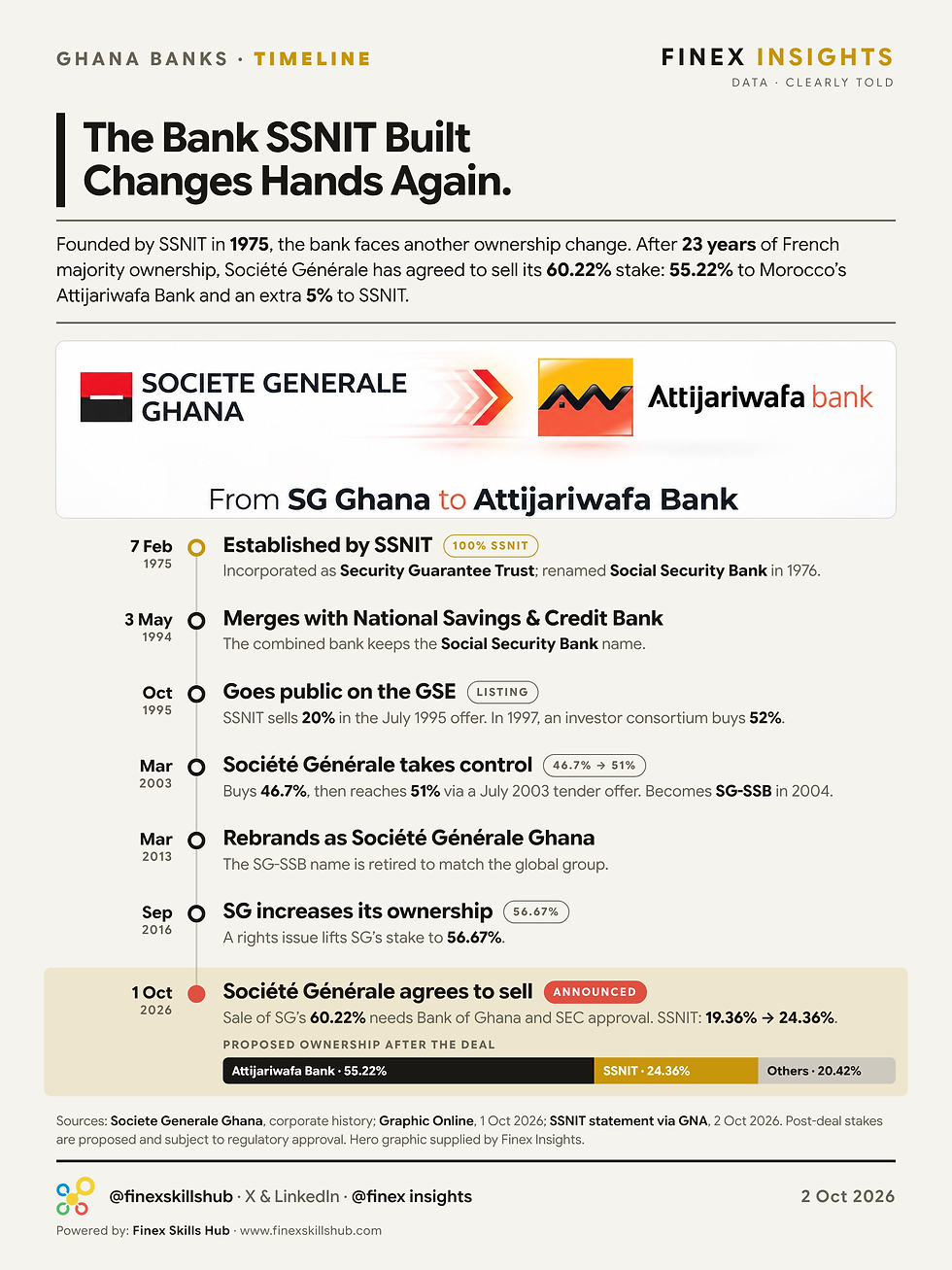
A significant structural change followed in May 1994, when SSB merged with the National Savings & Credit Bank while retaining the Social Security Bank name.
In 1995, the bank entered the public market. It made a public offer of 30% of its shares and was subsequently listed on the Ghana Stock Exchange in October.
This marked an important stage in its evolution from a wholly SSNIT-owned institution into a publicly traded commercial bank with a broader shareholder base.
How Société Générale Entered the Picture
The transition to foreign strategic ownership did not happen overnight.
In 1997, an international investment consortium acquired 52% of SSB's issued shares, while Allied Irish Banks was appointed technical partner.
In March 2003, France's Société Générale acquired a controlling 46.7% interest in SSB, subsequently increasing its shareholding to 51% through a tender offer in July.
The bank became SG-SSB Limited in March 2004, combining its established Ghanaian identity with that of its new majority shareholder.
Further capital transactions gradually increased Société Générale's ownership. Its stake reached 52.24% following a 2009 rights offer and 56.67% following another rights offer in 2016.
Meanwhile, the SSB identity was formally retired in March 2013 when the institution adopted the name Société Générale Ghana.
By the time of the October 2026 divestment announcement, the French group's holding stood at 60.22%.
The 2026 Deal: What Changes?
The proposed transaction will introduce Attijariwafa Bank as Société Générale Ghana's new majority shareholder, marking a transition from French to Moroccan strategic ownership.
However, the ownership distribution reveals another important development.
SSNIT, which previously held 19.36% of the bank, is acquiring an additional five percentage points from Société Générale. This will increase its total holding to 24.36%.
Based on the announced transaction, the resulting shareholder structure will be:
Attijariwafa Bank: 55.22%
SSNIT: 24.36%
Other shareholders: 20.42%
SSNIT will therefore retain a substantial minority interest in the institution it originally established, although Attijariwafa Bank will hold majority control.
The proposed divestment remains subject to the relevant regulatory approvals and other completion conditions.
Beyond a Change of Name
The history of Société Générale Ghana illustrates how the ownership of a financial institution can evolve considerably while the underlying banking business continues.
Over 51 years, the institution has moved from sole pension-fund ownership to a listed company, attracted international strategic investors, operated under French majority ownership and is now preparing for Moroccan majority ownership.
For SSNIT, the latest transaction also raises its economic exposure to an investment that dates back to the institution's founding.
The next chapter will depend not merely on the identity of the new majority shareholder, but on how the bank's strategy, capital position, governance and operations develop under the proposed ownership structure.
What began in 1975 as Security Guarantee Trust Limited has become part of a much wider story of Ghanaian banking, pension-fund investment and cross-border African financial integration.
The bank SSNIT built has changed considerably. Its founding shareholder, however, remains part of the story.
Join our WhatsApp group to receive data viz insights on Ghana and Africa directly: https://chat.whatsapp.com/JCqBvBWfqjILTxiaCqFhCx?mode=wwt
Finex Insights | Data. Clearly Told.
SEO keywords: Société Générale Ghana, Attijariwafa Bank Ghana, SSNIT bank ownership, SSB Bank history, Société Générale Ghana sale, Ghana banking history.


Comments