
Ghana’s 2025 Fiscal Outturn Reveals the Real Pressure Points in Government Spending.
Ghana’s actual fiscal outturn for 2025 presents a revealing picture of how government finances are evolving under mounting economic pressure. The latest figures show total revenue and grants reaching GH¢224.88 billion, while total expenditure climbed slightly higher to GH¢233.78 billion, resulting in an overall fiscal deficit of approximately GH¢8.9 billion.
At first glance, the gap between revenue and expenditure may appear manageable. However, a deeper look into the composition of both sides of the budget reveals the structural realities shaping Ghana’s public finances.
On the revenue side, the government continues to rely heavily on taxation as its primary funding source. Direct taxes, including income and property taxes, generated GH¢95.24 billion and accounted for 42% of total revenue, making them the single largest contributor to government inflows. Indirect taxes on domestic goods and services followed closely with GH¢74.20 billion, representing 33% of total revenue.
Together, these two tax categories contributed roughly three-quarters of all government revenue collected in 2025, underscoring the economy’s dependence on domestic taxation and consumption activity.
Non-tax revenue contributed GH¢27.87 billion, while international trade taxes, largely import duties, added GH¢23.30 billion. Grants contributed only GH¢1.82 billion, reinforcing the growing shift away from donor dependency toward domestically generated revenue sources.
On the expenditure side, the outturn highlights the extent to which government spending is dominated by recurrent obligations. Compensation of employees remained the largest expenditure item at GH¢78.97 billion, consuming 34% of total expenditure. This means more than one out of every three cedis spent by government went toward wages and salaries.
The second-largest spending category was grants to other government units at GH¢57.72 billion, followed closely by interest payments of GH¢49.89 billion. Interest costs alone accounted for 21% of total expenditure, illustrating the continued fiscal burden created by public debt obligations. The scale of interest payments also means a substantial portion of government resources is being used to service past borrowing rather than finance new development initiatives.
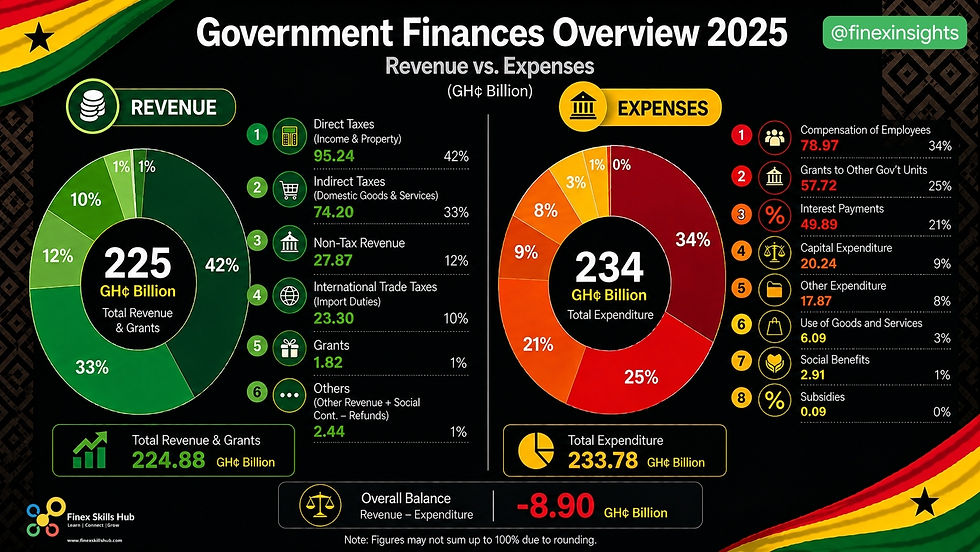
Capital expenditure stood at GH¢20.24 billion, representing just 9% of total spending. This relatively smaller allocation toward infrastructure and long-term investments raises broader questions about the balance between consumption-driven expenditure and growth-enhancing investment within the national budget framework.
Taken together, the 2025 fiscal outturn reflects a government operating within a highly constrained fiscal structure. Revenue performance remains relatively strong, particularly from domestic taxes, but expenditure rigidities continue to limit fiscal flexibility. With large commitments toward wages, transfers, and debt servicing, the room for discretionary spending and aggressive development investment remains narrow.
The figures ultimately reinforce a key economic reality: Ghana’s fiscal challenge is increasingly less about generating revenue and more about managing the structure and efficiency of expenditure. Sustained fiscal stability will likely depend on the government’s ability to control recurrent spending, reduce debt servicing pressures, and create more space for productive investment in the years ahead.


Comments